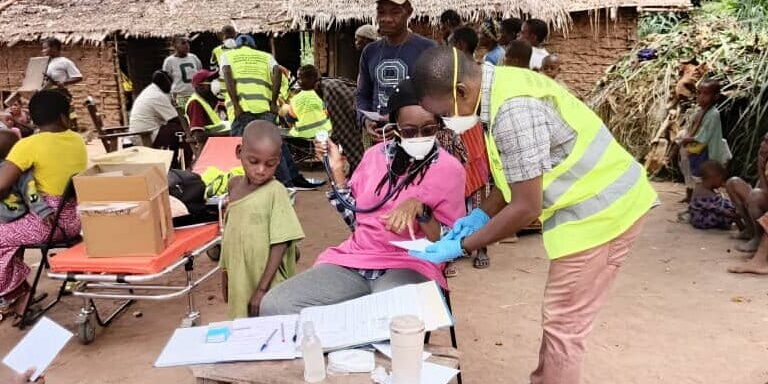
In the heart of Central African Republic’s (CAR) dense forests, a resilient Rwandan nurse has found her true calling: caring for underserved, remote communities. Braving challenging conditions, distance from her homeland, and the relentless risks associated with bringing healthcare to these impoverished, often overlooked, forest communities. This nurse’s steadfast commitment provides a lifeline to the region’s most vulnerable.
Her name is Aline Uwimana, a nurse from Rwanda who was deployed to work in CAR, courtesy of a program spearheaded by the international non-profit organization, Médecins Sans Frontières (Doctors Without Borders). This move is part of a broader initiative aimed at bringing healthcare services to some of the most impoverished communities globally.
Uwimana’s journey across the African continent to CAR started almost two years ago when she joined Médecins Sans Frontières. Her main task was to cater to the health needs of isolated communities living deep within the CAR’s dense forests. Armed with medical supplies, Uwimana treks into the forest daily, often on foot, for long distances to establish makeshift health outposts, treating malaria, respiratory infections, malnutrition, and more.
The CAR has been grappling with significant health challenges, with the World Health Organization identifying it as having one of the world’s worst healthcare systems. Political turmoil, frequent conflicts, and choking poverty have left its mark on the country’s health structure, yielding sobering statistics including sky-high maternal and infant mortality rates.
Therein lies the crux of Uwimana’s motivation. The nurse has insisted that working in CAR is the fulfillment of her calling, drawn to serve those in remote communities who otherwise would have limited, if any, access to essential healthcare services. Her dedication, however, comes with personal sacrifice.
Almost three thousand kilometers separate her home in Rwanda from her current location in CAR, and this distance extends beyond geography. Traditions, language, and daily life are markedly different, unveiling a uniquely complex blend of professional and cultural challenges. Uwimana often finds herself as a medical practitioner, friend, confidant, and bridge between contrasting worlds.
Her story has been aptly covered in recent times, becoming a testimony of extraordinary personal commitment for a noble cause. This recognition also highlights Médecins Sans Frontières’s crucial role in deploying health professionals like Uwimana to areas with dire healthcare needs.
Although the work of Uwimana and her cohorts in similar circumstances does make a palpable difference, their tale also underlines a deep-seated issue within the global health landscape. As per a World Health Organization’s report, half of the world’s population still has no full coverage of essential healthcare services. The lack of access is distinctively stark in areas marked by poverty, conflict, and remoteness, like CAR’s forest communities.
Uwimana’s work illuminates the triad of issues entwined in global health: the stark disparity in access, delivering healthcare amidst dire conditions, and the toll it takes on those who dedicate themselves to mitigate it.
“It’s challenging, but it is what I chose to do,” Uwimana stated during a recent interview. “I am here for the people. I am here to ensure they have access to healthcare.”
Waves of pandemic fears, escalating conflict, and entrenched poverty may continue to buffet the Central African Republic. Yet, amid this tumult, the enduring image of medical heroes like Uwimana offers a beacon of hope. Her tale champions a vision of rising to global health challenges, respecting the worth of every individual, regardless of where they live. It serves as a vibrant call to action for decision-makers, health care professionals, and ordinary citizenry alike.
Original Source: https://news.mongabay.com/2026/04/far-from-home-a-rwandan-nurse-fulfills-her-calling-among-car-forest-communities/