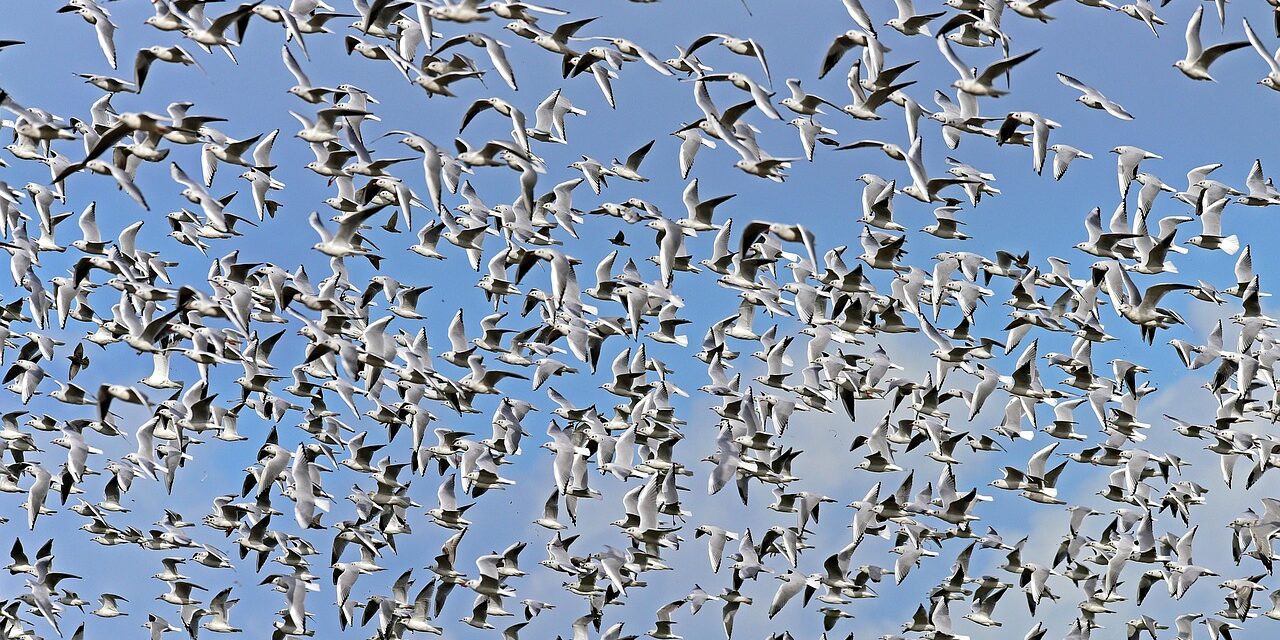
The latest breakthrough in avian research has unveiled a new model explaining how bird flocks can move in ways that seemingly contradict Newton’s third law of motion. This law states that for every action, there is an equal and opposite reaction; however, recent studies suggest that birds in a flock may not adhere to this principle in their united movements. The study, conducted by a team at the University of California, Berkeley, employs complex simulations and observational data to explain how these birds manage to move seamlessly without the expected interactions resulting in chaos.
The latest turn
This fresh perspective stems from research published last week, which reveals that birds can maintain cohesion in a flock through subtle movements and adjustments that are nearly imperceptible to the human eye. By harnessing sophisticated computational models, researchers demonstrated that birds may adjust their positions in response not merely to those closest to them but to the flock as a whole. The findings indicate that birds exhibit a kind of collective intelligence, allowing them to counterbalance individual impulses with group dynamics.
The study has sparked interest across various scientific disciplines, highlighting its potential implications beyond ornithology. By understanding the mechanisms powering bird flocks, scientists hope to uncover new insights applicable in fields like robotics, where autonomous drones could benefit from similar collective behavior algorithms.
How the story got here
Efforts to understand flocking behavior began decades ago when researchers observed the intricate choreography of migrating birds. Early models suggested that flock movement could be primarily understood through the lens of physical laws, attributing positions based on the forces exerted by neighboring birds. However, these models often fell short in accounting for the emergency-like shifts seen when flocks react to threats such as predators.
Previous attempts at modeling flock behavior relied heavily on Newtonian physics, but they were notoriously unable to replicate the nuanced movements observed in real-world scenarios. While many dismissed the phenomena as irrational, a small group of researchers remained intrigued, eventually leading to the current study’s revelations connecting behavioral ecology with complex systems theory.
Next expected developments
Looking forward, researchers aim to expand on these findings by exploring how these dynamics play out in other animal groups beyond birds. They believe that understanding these principles’ ecological, evolutionary, and computational relevance could contribute to advances in various domains. Future research may include field studies that record real-time flock movements to validate these models against natural behaviors in diverse species.
As scientists continue to investigate the underlying rules governing flocking phenomena, they anticipate multi-disciplinary collaborations that might bridge gaps between biology, physics, and technology. The next expected milestone will be the release of additional observational data this summer, which could provide further insights and help refine the established models. Scientists remain optimistic that unraveling the complexities of flock behavior will lead to groundbreaking advancements across different scientific sectors.
Original Source: https://www.sciencedaily.com/releases/2026/06/260615033843.htm