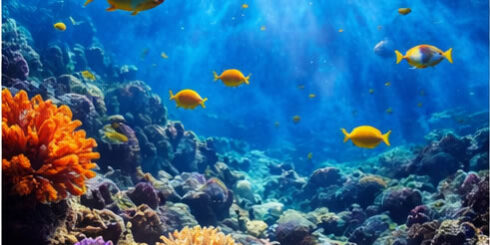
Japan’s coral reefs are marvels that serve as biodiversity hotspots, supporting tens of thousands of marine species. But how are these reefs linked? New research reveals the story behind this intricate network, attributing it to the Kuroshio Corridor’s role as a vital highway for distributing coral larvae.
The corridors, vast, rapid oceanic streamsystems, are a crucial factor in maintaining the connectivity of coral reefs around the Japanese archipelago. Studies illustrate how the Kuroshio Corridor, in particular, fosters geographically separated coral populations’ connectivity.
Lying in the western North Pacific, the Kuroshio current expands over 900 kilometers with a speed reaching up to four knots, making it the world’s second most potent and turbulent current. This immense flow, researchers have discovered, transports delicate coral larvae, allowing them to survive, grow, and inhabit far-reaching coastal areas.
These recent findings are a breakthrough for marine biology, ecosystem conservation, and climate change research. The discovery provides a fresh context for understanding the functioning and resilience of coral reef ecosystems. It opens the door for studying other ocean currents worldwide to see if they act similarly, providing a global arena to assess marine diversity impact.
Traditionally, scientists believed that coral larvae had limited dispersal capabilities due to their fragility. This made it difficult to explain coral’s geographical distributions. However, the role of the Kuroshio Corridor has been a paradigm shift.
In this investigation, researchers used advanced biophysical models to observe larval behaviors, oceanic conditions, and coral spawning events. They studied floating paths of coral larvae using simulations accounting for factors like currents, water turbulence, water temperature, and larval behavior. The study projected possible routes of larvae dispersal and explored why coral reefs present in these specific geographic sequences.
For coral-heavy Okinawa, the Kuroshio made all the difference. The results depicted that the huge amount of coral larvae from the Okinawan reefs would be swept up into Kuroshio, get carried along by the dynamic water flow, and eventually deposit in remote coastal areas. This creates an intricate island-hopping network of coral reefs, formed irrespective of geographical distance, ensuring healthier and more diverse marine ecosystems.
The team’s data further determined that larvae generated in the warmer months had higher survival rates. This hints that seasonal climate changes might affect the survival and dispersion of coral larvae significantly, potentially impacting future coral reefs’ distribution, leading them to be able to predict potential coral reef ‘hot spots.’
This research’s implications extend beyond marine biology. Coral reefs play crucial roles as natural barriers against tropical storms and tsunamis, protecting coastal regions. Understanding how current-driven larval dispersal shapes these reefs provides valuable knowledge for coastal management and natural disaster preparation.
On the flip side, the health of coral reefs is intrinsically linked with climate change and human activities. Warming oceans lead to devastating coral bleaching, while destructive fishing practices and pollution cause irreparable damage to these ecosystems. Understanding the way reefs are connected can help devise improved conservation strategies and potentially mitigate some of these challenges.
The Kuroshio Corridor has always been known as a critical player in the functioning of marine ecosystems and regional climate. Now, it appears it also plays a crucial role in shaping biological communities, a discovery that has broad implications for understanding our world’s oceans. These hidden highways of the sea are not only proving essential for the resilience of coral reefs but could hold more answers to the mysteries of marine biodiversity.
In conclusion, the Kuroshio Corridor, serving as an aquatic conveyor belt, has revealed the links between Japan’s geographically dispersed coral populations. This discovery sheds light on marine biodiversity, coastal protection, climate change, and ultimately, our understanding of the oceans.
Original Source: https://www.nature.com/articles/s41598-026-40448-z