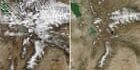
The unparalleled speed of snowmelt throughout the American West has recently astounded scientists. The phenomenon, often shrugged off as seasonal variability, is now being seen as an alarming indicator of the accelerating impact of climate change. A rich tapestry of snow that once blanketed the region has vanished at an alarming rate, prompting a wave of concern among researchers.
Western regions of the United States – from the lofty heights of the Rockies to the Sierra Nevadas, right down to the plains -have historically been covered by thick layers of snow during the winter. This snow anchors the regional climate and serves as a crucial water source for people, agriculture, and wildlife throughout the dry summer months. However, the typical patterns of accumulation and melt are being derailed.
“Speed is of the essence,” says Dr. Alex Hall, a climate researcher at the University of California, Los Angeles. “The water year usually starts off slow, accumulating snow over the fall and winter, with the payoff coming in the beautiful, slow release of water from the melting snow in spring and summer. What we’re seeing now is all that payoff arriving too quickly – and then it’s gone.”
Leanne Weber, a Ph.D. candidate at the University of Colorado Boulder’s Institute of Arctic and Alpine Research, is among the scientists tracking the speedy melt. “The scale and pace are on a whole other level,” she said. “It’s not just a few peaks melting a few weeks early; we’re talking about vast tracts of the American West turning from white to brown in the space of just a month.”
According to the U.S. Department of Agriculture’s Natural Resource Conservation Service, snowpack across the majority of the western states is well below normal. Combined with the fact that many areas have already warmed into the 70s, 80s, and even 90s Fahrenheit, and it’s not hard to understand the unprecedented evaporation and absorption rates.
According to scientists, these changes have profound implications for wildfires, agriculture, wildlife, and water supply. The earlier melting of the snowpack results in drier soil and vegetation, sparking wildfires. In turn, the damage to ecosystems negatively affects tourism and agriculture, causing a significant economic impact.
Dr. Kelly Gleason, a hydrologist from Oregon State University, warned of the potential for escalating water crises, pointing out that most reservoirs in the American West are designed to capture meltwater from snowpack. “When the snowpack disappears, so does our primary water source,” she said. “Snowpack decline is not a future problem—it’s a problem right now.”
Despite the immediate concern, many do not realize the severity of the issue, as the surface conditions seem to suggest a different narrative. When people see the snow melting, they often interpret it as a sign of a good spring without realizing the detrimental effects it will have on the environment in the subsequent months.
As the American West grapples with its newfound reality, scientists assert the importance of mitigating the impacts of climate change now more than ever. Accelerated investment in water conservation and infrastructure, as well as transitioning to more sustainable practices in agriculture and industry, is urgently needed.
The destabilizing patterns observed in Western snowpack are indicative of the wider impact of climate change globally. The speed of the changes observed acts as a stark reminder that the seeds of an impending crisis are being sown now, leaving the world on the brink of a tipping point that requires immediate action.
As snow disappears from the American West in a blink of an eye, the questions that need answering are not only what this means for our future but also what can be done to prevent this from becoming our new normal. The future of the world depends on the choices made today. As scientists have evidently conveyed: the time to act is now and the matter at hand has already escalated beyond mere environmental concerns.
Original Source: https://www.theguardian.com/us-news/2026/apr/01/snowmelt-american-west